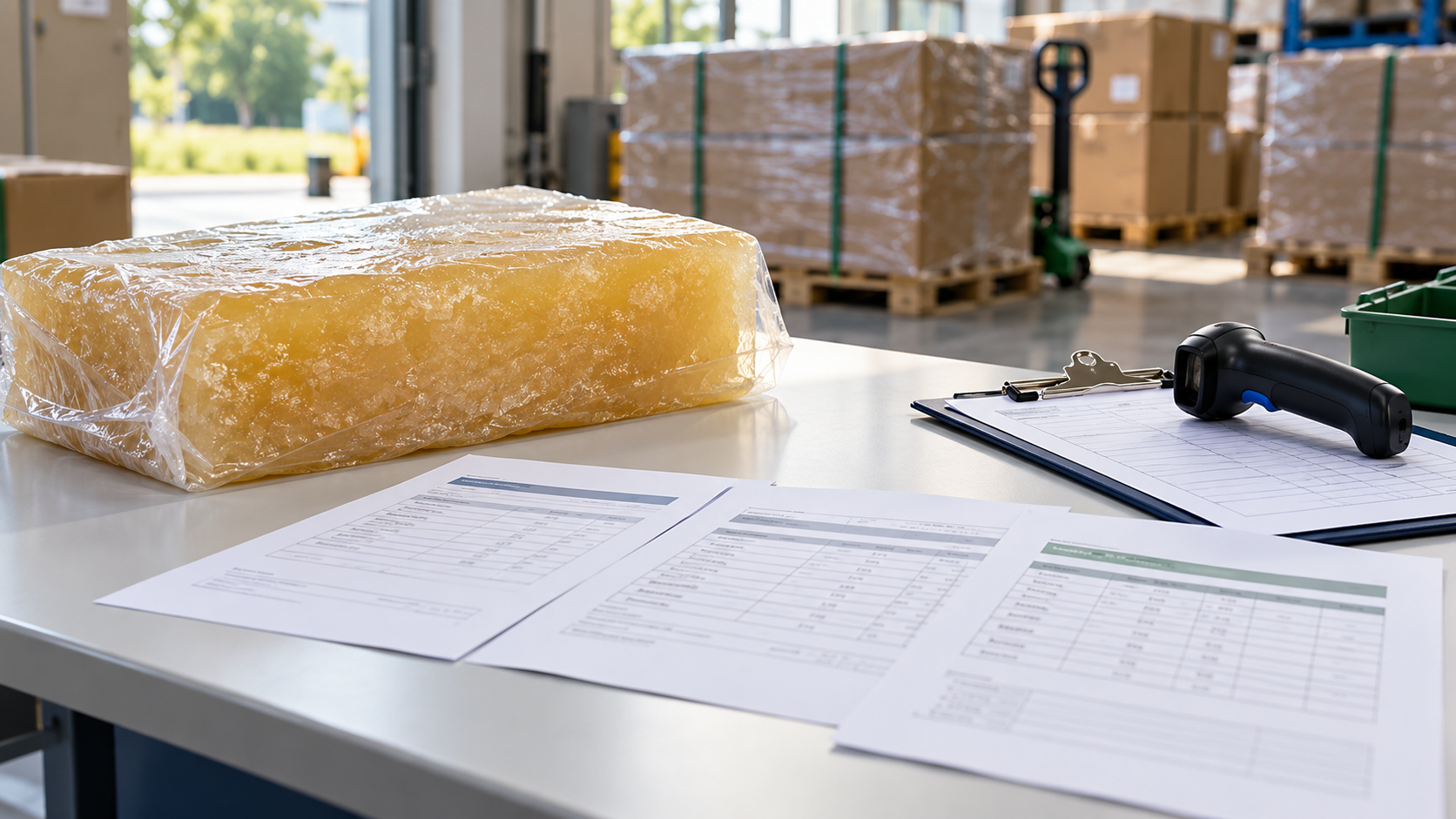


A rubber COA, TDS and SDS answer different purchasing questions. Use the certificate of analysis to review the supplied lot against agreed requirements, the technical data sheet to understand the grade, and the safety data sheet to plan safe handling. Connect all three to the same product identity before approving a shipment.
A document pack can look complete while leaving the buying decision unresolved. A familiar trade name may hide a different grade suffix. A typical property may be mistaken for a guaranteed limit. A clear safety document may accompany the wrong batch. The following checklist helps buyers and quality teams turn a collection of files into a traceable review.
1. What Each Document Establishes
| Document | Primary purchasing use | What to verify separately |
|---|---|---|
| COA: certificate of analysis | Review reported results associated with the supplied material or lot | Lot coverage, test basis and agreed acceptance limits |
| TDS: technical data sheet | Screen grade characteristics and intended applications | Whether values are typical, specified or guaranteed |
| SDS: safety data sheet | Communicate product hazards and handling information | Correct product, applicable market and current revision |
These are working distinctions for procurement. Suppliers do not all use identical document titles or formats. Read the actual statements and agree the required contents before ordering. A document headed “quality certificate” may need clarification before it can serve the same purpose as the requested COA.
2. Start with Product and Lot Identity
Record the producer, full trade name, grade code, relevant suffix, purchase order and supplier reference. Then map the lot identifiers on the COA to the bale labels, pallet labels and packing list. If one delivery contains several lots, ask which document covers each one.
Do not silently remove spaces, leading zeroes or suffixes while matching identifiers. They may be meaningful. Where the distributor uses an internal reference, request a clear link to the producer’s identifier rather than assuming the two codes are interchangeable.
For example, a buyer might receive two pallets with different lot codes and a single certificate. The useful follow-up is whether both lots are covered and how their results are presented. The mere presence of a PDF does not answer that question. Resolve the mapping before releasing the material into normal stock.
3. Read a Rubber COA Against the Agreement
Ask which characteristics are reported, which test methods apply and whether the reported values are actual measurements, calculated values or another declared basis. Preserve units, conditioning details and material state where they affect comparison. A result for raw polymer does not automatically establish the performance of a cured production compound.
Use the acceptance limits agreed for that grade and order. Avoid creating a new tolerance after delivery simply because a number differs from a previous lot. If a critical requirement was omitted from the purchase specification, engineering and purchasing should agree how to address the gap.
As a manufacturer example, ARLANXEO’s Keltan KSA quality information distinguishes sales specifications with test methods and ranges from order-related COAs. This illustrates why a specification and a certificate should be reviewed together; it is not a statement that every rubber supplier provides an identical document pack. See the producer’s published explanation.
4. Separate Typical TDS Values from Limits
A TDS helps narrow the grade shortlist. However, a typical value is not automatically an acceptance boundary for every delivered lot. Look for qualifying language, footnotes, issue dates and references to separate sales specifications. Ask the supplier to identify which document controls the order.
When comparing grades, keep the test conditions beside the number. Mooney viscosity and Shore hardness, for example, describe different things. Similar-looking values do not establish equivalent processing or finished-part behavior.
Retain the TDS revision used during qualification. If a later revision changes a property description, ask whether the material changed, the reporting basis changed or only the presentation changed. The answer determines whether a new technical review is needed. Do not infer a formulation change from a revised document date alone.
5. Keep Safety Review Separate and Connected
The SDS supports hazard communication and safe handling. It should match the product being received. Give the relevant version to the people responsible for unloading, storage and processing, and resolve any product-identity mismatch with the supplier.
For the US hazard-communication framework, OSHA’s public guidance describes a standardized 16-section SDS covering matters such as identification, hazards, handling and storage. Buyers should use the applicable document and local requirements for their destination. An SDS does not replace lot-specific quality evidence. OSHA’s SDS overview explains the document structure.
Route handling questions to the responsible workplace safety team. Purchasing should preserve the product identity and revision history so that technical and safety reviews refer to the same material, rather than offering an informal interpretation of unfamiliar safety instructions.
6. Build a Document Review Checklist
- Match the complete grade designation across the order, labels and documents.
- Map every received lot to its relevant certificate.
- Check the specification revision and agreed limits.
- Retain methods, units and meaningful test conditions.
- Distinguish measured results from typical or declared values.
- Confirm the appropriate SDS version is available to the responsible team.
- Record missing information, its owner and the release decision.
Use a short status field for each item: accepted, clarification required or not applicable with a reason. This makes an incomplete pack visible without implying that every missing field is a material failure. The review should support a decision, not merely collect signatures.
7. Resolve Mismatches Before Production Release
If the certificate references a different grade or lot, preserve the original files and label photographs. Ask for a corrected document or a written explanation linking the identifiers. Do not edit the supplier’s certificate to make it match your internal system.
If a result appears outside the agreed limit, follow the established quality process. Keep the affected material identifiable while the responsible team reviews the discrepancy. Do not average results across different lots to hide a problem or treat a supplier’s verbal reassurance as a replacement for the required evidence.
A technically acceptable deviation may still need documented approval. Record who approved it, which quantity and lot it covers, and any restrictions. A one-order exception should not silently become the specification for future purchases.
8. Ask for the Pack in the RFQ
Document expectations work best when they are clear before commercial agreement. Request the current TDS and applicable SDS during qualification. Define the expected COA contents, lot identification and delivery timing in the order requirements.
A practical request is: “Please confirm the full producer and grade designation, applicable specification revision, certificate coverage for each supplied lot, reported characteristics with methods and units, and the available safety data sheet for our destination.” Add your application-specific requirements rather than sending an unlimited list of unrelated tests.
Connect the document review to physical receiving checks. Our synthetic rubber receiving checklist addresses the related task of checking incoming material and storage information. Confirm the actual approved receiving procedure for your site.
9. Frequently Asked Questions
Can an SDS replace a rubber COA?
No. Hazard communication and lot-related quality review serve different purposes. Request the evidence needed for each decision.
Does a TDS guarantee every listed value?
Read its qualifications and the agreed sales specification. Do not convert typical values into acceptance limits without agreement.
Must every COA contain the same tests?
No universal test list is proposed here. Define the required characteristics for the material and purchasing agreement.
Does an acceptable COA approve a new compound?
No. Grade qualification, formulation trials and finished-part validation remain separate decisions where required.
10. Conclusion and Sources
Use a rubber COA to support the agreed lot review, a TDS to understand the grade and an SDS to support safe handling. Keep their identities connected, preserve the test basis and revisions, and close discrepancies before normal production release.
Reviewed October 27, 2026. This is an original procurement checklist, not a supplier-specific certificate template or laboratory procedure. Google Trends was inaccessible; no measured trend claim is made.
Send the reference grade, application, required certificate fields, trial quantity and destination. Ask which grade-specific documents are available before confirming your purchasing requirements.
Request a Quote
Leave a Reply