
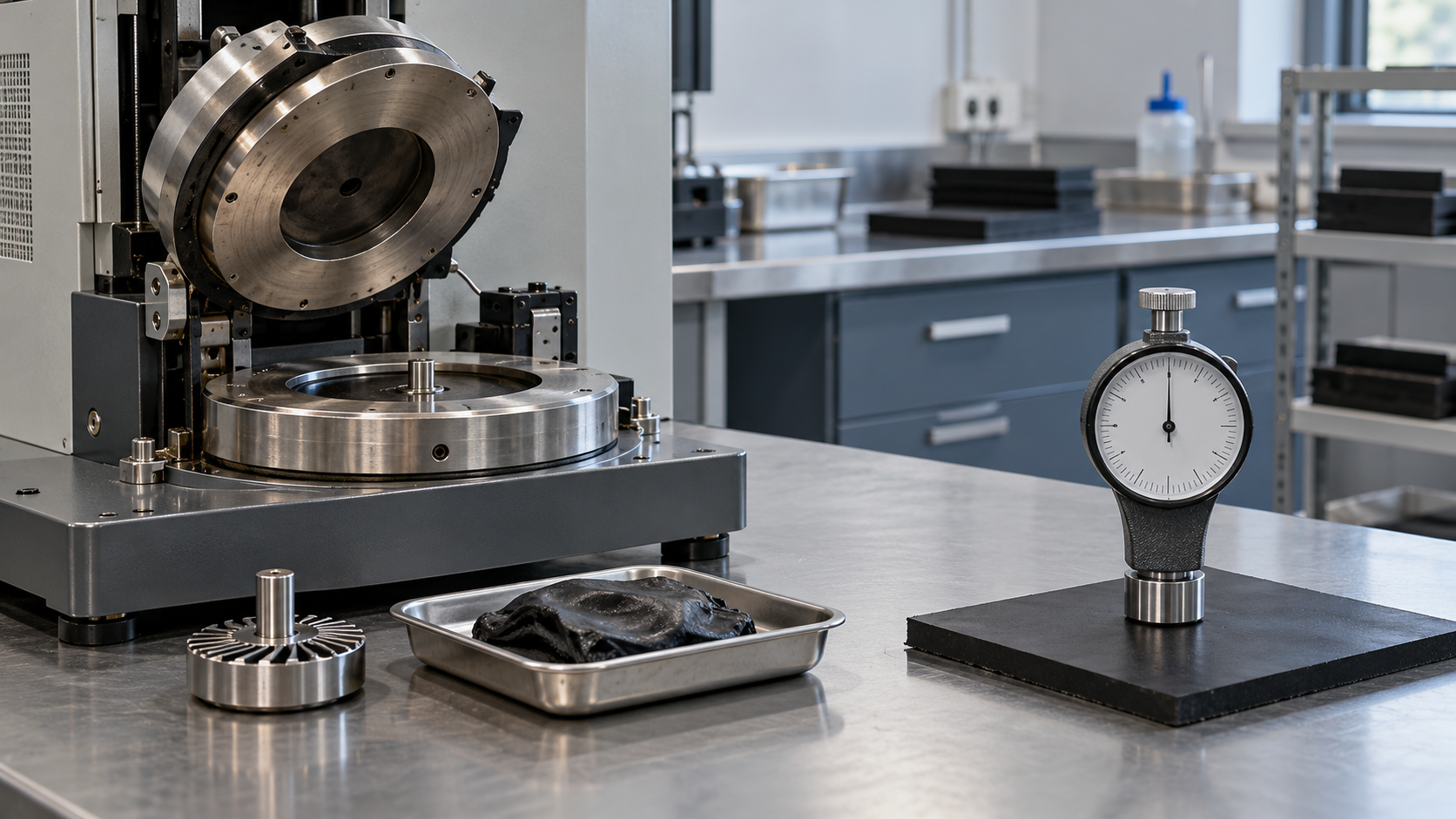


Mooney viscosity and Shore hardness measure different behavior and are not interchangeable. Mooney testing concerns uncured rubber under a defined shearing-disc procedure; Shore testing concerns indentation hardness of vulcanized or thermoplastic rubber. Buy raw SBR or NBR using the exact grade and processing specification, then verify the finished compound against its own requirements.
1. Key Takeaways
- A number on a raw-polymer COA is not automatically a hardness rating.
- Compare viscosity results only with their method and conditions.
- State the durometer scale when specifying Shore hardness.
- Link raw material, compound recipe and finished-part approval through a controlled trial.
- Do not convert Mooney units into Shore hardness using a purchasing shortcut.
2. Start with the State of the Material
Before comparing two results, ask what was tested: a raw bale, an uncured compound, a cured laboratory plaque or a finished part. These descriptions are not administrative details. They define which requirement the evidence can support.
A rubber manufacturer can legitimately require both raw-material processing checks and cured-product performance checks. Procurement should preserve the distinction on enquiry forms, sample requests and purchase orders. If a supplier receives an instruction for a particular hardness but the order is for raw polymer, the missing compound and cure basis must be clarified.
Keep the producer and full grade designation visible alongside the test result. A family name such as NBR is insufficient to identify an approved input. The report should also state the relevant batch, material form and reference conditions.
3. What Mooney Viscosity Measures
ISO 289-1 describes a shearing-disc method for measuring Mooney viscosity of uncompounded or compounded rubber. Its scope concerns unvulcanized rubber. A reported value belongs to the defined test basis; it should not be read as a finished-part hardness measurement.
In practical document review, retain the complete viscosity notation rather than copying only its numeric value into a spreadsheet. Request the measurement conditions and ask the technical team which differences would make two records unsuitable for direct comparison.
For example, a quotation may provide a grade range while a COA provides a result for a particular batch. Put these records in separate columns: proposed specification, batch result and approval decision. This prevents a typical producer datasheet value being mistaken for the acceptance limits of the order.
4. What Shore Hardness Measures
ISO 48-4 addresses indentation hardness by durometer for vulcanized or thermoplastic rubber and identifies different scales. A Shore requirement should therefore include the scale and test basis rather than simply stating a number followed by the word hardness.
The specimen and material identity also matter to a buyer’s review. Ask whether a result comes from a reference plaque, a production sample or the actual finished part. Engineering should define which evidence is acceptable under the drawing and test procedure.
Do not assume that a hardness result proves every aspect of a component’s function. Preserve separate requirements for the other properties and application tests included in its approval. A release checklist is strongest when each measurement has a clear purpose.
5. A Purchasing Comparison Table
| Question | Mooney viscosity | Shore hardness |
|---|---|---|
| What does the cited method address? | Shearing-disc viscosity of unvulcanized rubber | Indentation hardness of vulcanized or thermoplastic rubber |
| What evidence should identify? | Material, batch and viscosity test conditions | Compound or part, scale and hardness test basis |
| Where might a buyer use it? | Defined raw-material or uncured-compound review | Defined cured-material or component review |
| What should not be inferred? | Finished-part hardness or guaranteed service life | Raw-polymer viscosity or complete component approval |
| Can one replace the other? | No. Retain separate requirements and evidence. | |
This table summarizes the distinction, not the detailed test procedures. The responsible laboratory should use the full applicable method and the buyer’s agreed specification.
6. Why a Grade Number Is Not a Hardness Number
Rubber grade designations identify a producer’s product. They are not a general numbering system for finished-part properties. Read the exact producer datasheet instead of interpreting a suffix or familiar-looking number as a promised result.
ZEON’s Nipol NBR portfolio, for example, lists grade identity, acrylonitrile content and Mooney viscosity as separate selection information. This illustrates why a buyer should request the actual grade record. It does not establish equivalence to another manufacturer’s designation or prove the performance of Linwell-supplied material.
When considering an alternative, keep a controlled record of the approved input and the reason for the change. Ask whether material form, variant and other relevant characteristics align before spending time on a production trial. An alternative quotation is a candidate for review, not a technical approval.
7. Build a Controlled Trial
- Define the approved reference polymer and production compound.
- Agree which raw-material properties and methods are critical.
- Match the sample to its producer, grade and batch documents.
- Keep a documented baseline recipe and processing route.
- Record mixing and processing observations using the agreed trial plan.
- Prepare and test the cured compound on its own acceptance basis.
- Complete the component or application trial required by engineering.
- Record approval, limits on use and change-notification requirements.
If the team changes the recipe during evaluation, identify that change in the report. A successful adjusted recipe may support approval, but it is a different basis from an unchanged substitution. Retaining both trial records prevents later repeat orders from relying on an undocumented adjustment.
8. Resolve Conflicting Batch Results
When a processing problem appears, preserve the batch identity and original test records before drawing a conclusion. Check whether the incoming test and supplier result refer to the same material and comparable conditions. A discrepancy should start an investigation, not an automatic accusation.
Separate the questions in the action log. Quality can check sample identity and laboratory comparison; engineering can review the production trial; procurement can request the issuer’s clarification. Keep original and corrected documents together so the review history remains understandable.
If the raw-material result meets its agreed specification but the cured product fails a hardness requirement, the next decision belongs to the defined investigation procedure. Do not assume the polymer is either cleared or at fault from one number. Review the complete approval basis and actual production records.
9. Write a Clear RFQ and Document Request
- Identify whether the purchase is raw polymer, uncured compound or finished components.
- Provide producer and full grade identity for the reference material.
- State the critical viscosity test basis for the input material.
- Keep cured hardness requirements separate and identify their scale.
- Request TDS, proposed batch COA and applicable safety information.
- Explain the trial stage, quantity, destination and intended processing route.
- Define which changes require technical review before further supply.
Use the technical document guide to separate grade information from batch evidence. The SBR batch variation article can help organize a repeat-supply investigation.
A concise enquiry with a traceable specification is more useful than an extensive list of unrelated properties. Include the information needed for the actual buying decision and assign an owner to missing technical requirements.
10. FAQ
Can Mooney viscosity be converted into Shore A hardness?
No direct conversion is proposed. They describe different measurements and material states; request the separate relevant tests.
Does a higher Mooney value guarantee a harder finished part?
No. A raw-material viscosity result is not a finished-part hardness guarantee. Use the actual compound qualification evidence.
What should accompany a Mooney result?
The material and batch identity, complete test notation and applicable measurement conditions. Align the comparison basis with your technical team.
Is a hardness-only RFQ enough for raw NBR?
No. Identify the raw grade and processing requirements, then clarify the compound and cure basis behind the finished-product target.
Can two materials with the same test number be substituted?
Not automatically. Grade identity and the complete trial requirements still need review. A matching number does not establish equivalence.
11. Conclusion
Separate the raw-material buying specification from cured-product approval. Use Mooney viscosity for its defined uncured-rubber question, Shore hardness for its defined indentation question, and a documented trial to connect the input grade to the actual production result.
12. Sources and Review Basis
- ISO 289-1:2015: Mooney viscosity scope
- ISO 48-4:2018: Shore hardness scope
- ZEON: Nipol NBR grade selection information
Reviewed October 14, 2026. Definitions draw on public standard scopes; the enquiry workflow and checklists are practical recommendations. No Linwell inventory, test capability or material performance is implied. Google Trends data could not be retrieved; no measured trend or popularity claim is made. The generated laboratory cover is illustrative.
Send your reference grade, application, test requirements, trial quantity and destination. Ask which grade-specific technical and batch documents can be provided before arranging a controlled production trial.
Request a Quote
Leave a Reply