


1Key Takeaways
- Batch-to-batch variation in SBR 1502 is normal in emulsion SBR; the buyer’s job is to define which parameters must stay inside a controlled window, not to expect identical values in every lot.
- The parameters that most often explain processing differences between lots are Mooney viscosity, volatile matter, ash and the cure characteristics measured in a standard recipe.
- A COA is batch-specific; a TDS states guaranteed specification ranges. Both are needed before a trial order, and they must reference the same test methods.
- Two lots that pass the same specification can still process differently if the test methods, sampling or storage history differ.
- A short qualification checklist (documents, sample tests, trial batch, storage conditions) prevents most “the second container behaves differently” surprises.
2Why SBR 1502 behaves differently from lot to lot
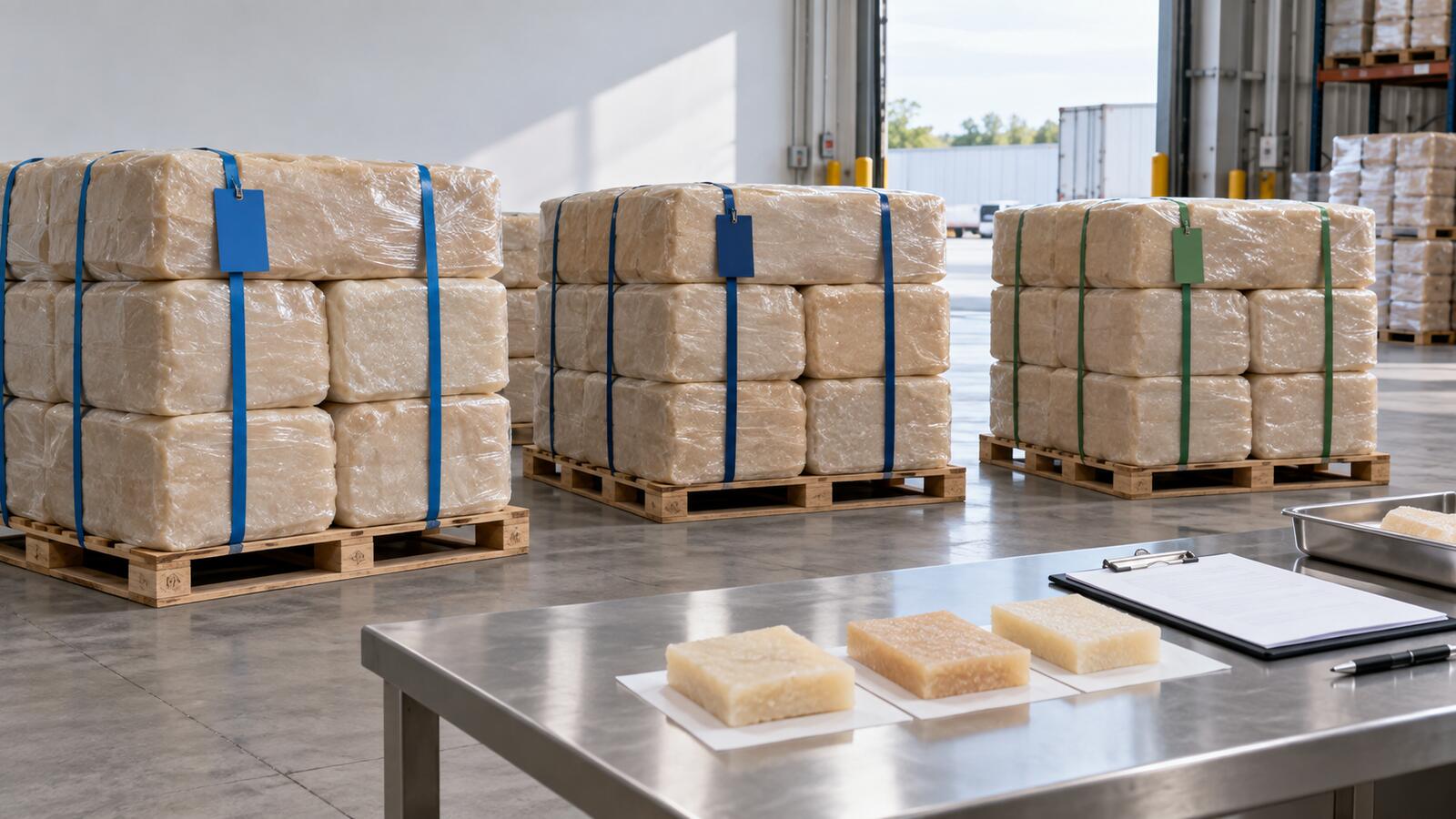
SBR 1502 is an emulsion-polymerised styrene-butadiene rubber: a copolymer of styrene and butadiene produced by cold emulsion polymerisation with resin and fatty acid soaps, stabilised with a non-staining antioxidant and supplied as baled, non-oil-extended rubber. Published grade data for SBR 1502 typically shows a bound styrene content around 22.5-24.5% and a Mooney viscosity window rather than a single value (for example 46-56 or 48-58 ML(1+4) at 100 °C depending on the grade class), with the test methods referenced to ASTM D 1646 for Mooney viscosity, ASTM D 5668 for volatile matter and ASTM D 5667 for ash.
Those ranges are not a defect in the material. They are the natural result of a continuous process: monomer ratios, conversion, coagulation, drying and baling all move slightly between campaigns and between lots, and the specification window is designed to absorb that movement. The practical question for a buyer is therefore not “are all lots identical” but “do all lots stay inside the window my process needs”.
3What buyers usually notice first
Variation rarely shows up as a failed COA. It shows up later, in production:
- Mixing time drifts. One lot reaches a workable state faster than the previous one, so the mixing cycle that was tuned last month now either over-mixes or under-mixes.
- Extrusion or calendering changes. Surface roughness, die swell or sheet dimensions shift between lots of the same nominal grade.
- Cure time moves. Scorch time and time-to-90% cure measured in the buyer’s own recipe do not match the previous lot, so press cycles need adjusting.
- Scrap appears at the wrong end of the line. Defects show up in the first days after a container is opened, which points to lot-specific behaviour rather than a design problem.
- Documentation gaps create avoidable delays. The COA quotes a different test method or a different units convention than the TDS, and the qualification file cannot be completed.
For a sourcing team, these symptoms translate into two risks: unplanned rework in production, and a qualification process that cannot be closed because the documents do not line up.
4Root causes of variation in emulsion SBR
- Polymerisation and conversion control. Small differences in conversion change molecular weight distribution, which appears as a Mooney viscosity shift.
- Bound styrene content. Styrene content influences hardness, strength and cure behaviour. Suppliers typically hold it inside a tolerance (for example 23.5% ±1.0%), but a lot at the low end and a lot at the high end of the same tolerance will not process identically.
- Residual volatiles and moisture. Volatile matter that is higher than normal can create porosity or dimensional instability and can affect weighing accuracy in the mixer.
- Ash and inorganic residues. Emulsion residues and coagulant carry-over raise ash content; above the normal window it affects cure and ageing behaviour.
- Antioxidant level and type. Stabiliser content is a range, not a fixed number, and it influences storage behaviour as much as processing.
- Storage and transport history. Unvulcanised rubber is not inert. Published compounding references note that Mooney viscosity can change during storage, and grade datasheets specify storage conditions (protected from direct sunlight and precipitation, below a stated temperature) with a defined shelf life. A lot that sat in a hot container is not the same lot it was at the factory gate.
- Sampling and test methods. Two labs testing the same bale can report different Mooney values if they use different rotor pre-heat times, test temperature or sample preparation.
Cause 6 and 7 are the ones buyers most often overlook, because both look like “supplier variation” while actually being transport or measurement effects.
5Which parameters to control, and how they are measured
The following parameters are the ones commonly published for SBR 1502 and its close relatives. Typical test methods are shown because a COA without a method reference cannot be compared with a TDS.
| Parameter | What it tells the buyer | Typical test method |
|---|---|---|
| Mooney viscosity ML(1+4) 100 °C | Processability, mixing and extrusion behaviour | ASTM D 1646 / ISO 289-1 |
| Bound styrene | Hardness, strength, cure behaviour | ASTM D 5775 (supplier method) |
| Volatile matter | Drying quality, porosity risk | ASTM D 5668 |
| Ash | Inorganic residue level | ASTM D 5667 |
| Organic acid / soap | Emulsifier residue balance | ASTM D 5774 |
| Tensile strength, 300% modulus, elongation (standard recipe) | Compound performance benchmark | ASTM D 412 with recipe per ASTM D 3185 |
| Cure characteristics ML, MH, ts1, t50, t90 (MDR) | Press cycle and scorch safety | ASTM D 5289 |
Values or ranges shown on a supplier datasheet are for technical reference unless they are incorporated into an agreed specification. If your process needs a narrower control range, confirm it in writing with the supplier before ordering.
6Batch verification table: what to record for every lot
This table is the practical core of the article. For each incoming lot, record the supplier value and the buyer-verified value side by side. Discrepancies between the two columns are where problems start.
| Check | Source | Supplier value | Buyer verification | Action if outside buyer window |
|---|---|---|---|---|
| Lot / batch number and date of manufacture | COA, bale marking | Reject if markings and COA disagree | ||
| Mooney viscosity ML(1+4) 100 °C | COA | In-house Mooney or third-party test | Retest a second bale before accepting | |
| Bound styrene | COA / TDS | Verify against TDS range | Review cure recipe before release | |
| Volatile matter | COA | Check if mixer shows weighing or porosity issues | Dry or reject per internal rule | |
| Ash | COA | Compare with previous lots | Quarantine pending review | |
| Tensile / modulus / elongation in standard recipe | COA | Compare with reference compound | Adjust only after confirming the cause | |
| Cure characteristics (ML, MH, ts1, t90) | COA | Own MDR curve in own recipe | Re-tune press cycle or reject | |
| Packaging condition, bale film, contamination | Visual | Inspect on receipt | Segregate contaminated bales | |
| Storage conditions since dispatch | Supplier / freight | Check container temperature history if available | Prioritise consumption of affected lots |
7Grade selection logic
Choosing between 1502-type grades is a decision about process window, not about quality ranking:
- SBR 1502 – the general-purpose, non-oil-extended emulsion grade used across a wide range of rubber products; a reasonable starting point when the requirement is a balanced, well-documented general grade.
- SBR 1502E – positioned for rubber products where a different specification window (for example a different Mooney class or supplier-specific “E” designation) fits the buyer’s process better.
- NBR grades (for example NBR 3345) – selected when oil resistance is the driving requirement rather than general-purpose mechanical behaviour. Acrylonitrile content drives that trade-off: published elastomer references place NBR’s bound acrylonitrile between roughly 18% and 50%, with higher ACN improving oil and fuel resistance while reducing low-temperature flexibility.
The decision rule that avoids most disputes: define the process window first (mixing, extrusion, cure), then select the grade whose published window sits inside it, then verify with a trial lot.
8Trial and qualification checklist
- Collect the TDS and at least one batch-specific COA for the exact grade and lot to be trialled.
- Confirm that TDS and COA reference the same test methods and units.
- Verify bale weight, packaging and marking against the shipping documents.
- Run a reference mix using a standard recipe (for example the ASTM D 3185 recipe) and compare cured properties with the buyer’s current material.
- Measure cure characteristics with the buyer’s own MDR conditions; record ML, MH, ts1, t50 and t90.
- Produce a short production trial on the real line, and record scrap rate, cycle time and any surface or dimensional deviation.
- Repeat the trial with a second lot of the same grade before releasing the supplier to routine supply.
- Store the remaining trial material under the datasheet conditions and re-test after the planned storage interval.
- Close the qualification file with COA, TDS, SDS, trial report and the internal approval signature.
9Documents a buyer should verify
- TDS (Technical Data Sheet) – states the supplier’s guaranteed specification values. It is a commercial document rather than a legally mandated one.
- COA (Certificate of Analysis) – states the actual measured values for the specific manufactured batch. Batch number and test methods must be visible.
- SDS (Safety Data Sheet) – the hazard, handling, storage and transport document. In the EU it is required under REACH and must follow the regulated 16-section structure.
Three documents, three different jobs. A qualification file that only contains a TDS cannot demonstrate which batch was actually received, and a COA without method references cannot be compared with the TDS.
10RFQ information checklist
Include the following in a synthetic rubber RFQ so that quotations are comparable:
- Grade and polymer type (for example SBR 1502, SBR 1502E, NBR 3345)
- Required parameter windows: Mooney viscosity, bound styrene, volatile matter, ash
- Required test methods for each parameter
- Recipe and cure test conditions expected for the trial
- Quantity per order and expected annual volume (used for planning, not as a Linwell commitment)
- Packaging format and bale weight expected
- Documentation required: TDS, COA per batch, SDS, and the language needed
- Destination port and preferred shipping terms
- Storage and shelf-life expectations
- Target trial date and the person responsible for the technical evaluation
Lead time, MOQ, availability and other commercial terms vary by enquiry and should be confirmed in writing before ordering.
11FAQ
Can I require a single Mooney viscosity value instead of a range? A narrowed window can be discussed with a supplier, but it has to be agreed contractually and verified per lot. Narrowing the window may also reduce the number of lots available to you.
Why do two lots with the same COA values still process differently? Check storage history, sampling method and the buyer’s own test conditions first. Two labs can report different Mooney values for the same bale if pre-heat time, temperature or sample preparation differ.
Is a COA enough for qualification? No. The TDS defines the guaranteed window, the COA proves the batch, and the SDS covers handling and transport. A trial report closes the file.
Do all SBR 1502 suppliers publish the same specification window? No. Common windows for Mooney viscosity and bound styrene are similar but not identical, and suppliers differ in the methods they cite. Compare windows, not single values.
How much material should a trial order contain? The quantity depends on the buyer’s process. Allow enough material for a reference mix, a production-line trial and a repeat test after storage, then confirm the exact trial quantity with the supplier before ordering.
Where should a buyer start? Start with the process window and the documentation. A supplier that can explain the method behind each value is easier to qualify than one that only sends a price.
12Conclusion
Batch-to-batch variation cannot be eliminated in emulsion SBR, but it can be managed. Define the parameter window your process actually needs, record supplier values and your own verified values for every lot, verify the documents that matter, and qualify with a trial rather than with a price list. That sequence turns variation from a recurring production surprise into a controlled, auditable sourcing variable.
Technical information is provided for general reference. Confirm grade-specific specifications and commercial terms in writing before ordering.