


1Key Takeaways
- Use storage instructions for the exact producer, grade and supplied form.
- Link production dates, packaging condition and batch documents to each receiving decision.
- Rotate released stock against the producer’s storage basis and your consumption plan.
Store raw SBR and NBR according to the exact producer’s instructions, retain batch identification, protect the original packaging, and check the delivery before releasing it to production. A general rubber shelf-life table is not enough to approve a raw rubber shipment. The material form, grade, production date, transport history and stated storage conditions all matter.
For a buyer, storage begins before the purchase order. A useful RFQ connects the proposed shipment to the factory’s consumption schedule, available warehouse space and receiving checks. That makes it easier to identify a shipment that could spend too long in stock or arrive without the information needed for release.
This guide concerns raw synthetic rubber, especially SBR and NBR bales. It provides a practical procurement and receiving workflow; the producer’s current instructions and your quality procedures determine acceptance limits.
2Distinguish raw rubber from finished rubber products
Raw rubber bales and finished seals belong to different storage contexts. ISO 7664 addresses raw natural and synthetic rubber delivered in bales. Its public abstract also highlights the additional care needed for particulate material, including possible agglomeration under elevated temperature or pressure. ISO 2230:2026 concerns vulcanized or thermoplastic rubber products and explicitly excludes raw rubber in bale, liquid or particulate form. [1, 2]
This distinction matters when searching for “NBR shelf life.” A table intended for moulded O-rings does not establish the usable storage period of an uncured NBR bale. Likewise, a finished product’s service temperature is not a recommended warehouse temperature for raw polymer.
Start each storage instruction with three identifiers: producer, full grade designation and supplied form. ZEON’s NBR portfolio includes bale, crumb, powder and liquid forms, illustrating why the polymer family alone is insufficient. [3]
3Confirm the storage basis before ordering
Ask the supplier for the current grade-specific storage instructions and the basis for any stated shelf life. Clarify whether time runs from production, packing or another defined event. Record the production date separately from the dispatch date; a recent shipment can contain older stock.
Request a proposed batch allocation when available. If the final batches will be confirmed later, put the required date and document checks into the order terms rather than assuming the first quotation applies to every shipment.
The following questions form a practical purchasing checklist:
- What producer and exact grade will be supplied?
- Which batch or lot numbers and production dates are proposed?
- What storage conditions and storage period does the producer specify?
- What packaging, bale wrapping and pallet arrangement are included?
- Does the producer identify a review or retest procedure for older stock?
- Which records will accompany each lot?
- Is the expected remaining storage period compatible with our production plan?
A certificate of analysis describes the reported batch results. It does not, by itself, document every warehouse or transport exposure after testing. Keep the COA, producer instructions and shipment records as separate parts of the release decision.
4Match warehouse controls to the actual grade
Use the producer’s specified conditions to establish warehouse controls. Synthetic rubber transport guidance identifies dryness, protection from direct sunlight and, for some materials, cool storage as relevant considerations. It also describes the importance of clean handling and protection against contamination. [4]
Avoid announcing one universal temperature or storage duration for all SBR and NBR. If a document is missing, obtain it rather than substituting an internet table. Where a specification gives a temperature limit, consider the conditions near the actual pallet, not only a sensor elsewhere in the building.
As an internal operating checklist, identify heat sources, water ingress points, direct sunlight, cleaning chemicals and traffic that could damage packaging. Assign a location to every pallet and record movements. Keep grade and lot segregation clear enough that an operator can select the approved material without relying on memory.
Check stacking and handling against the packaging instructions. A pallet that looks tidy can still have damaged wrapping or an unreadable batch label. Changes in bale shape should be documented and assessed in context rather than treated as automatic proof of degradation.
5Inspect the shipment before production release
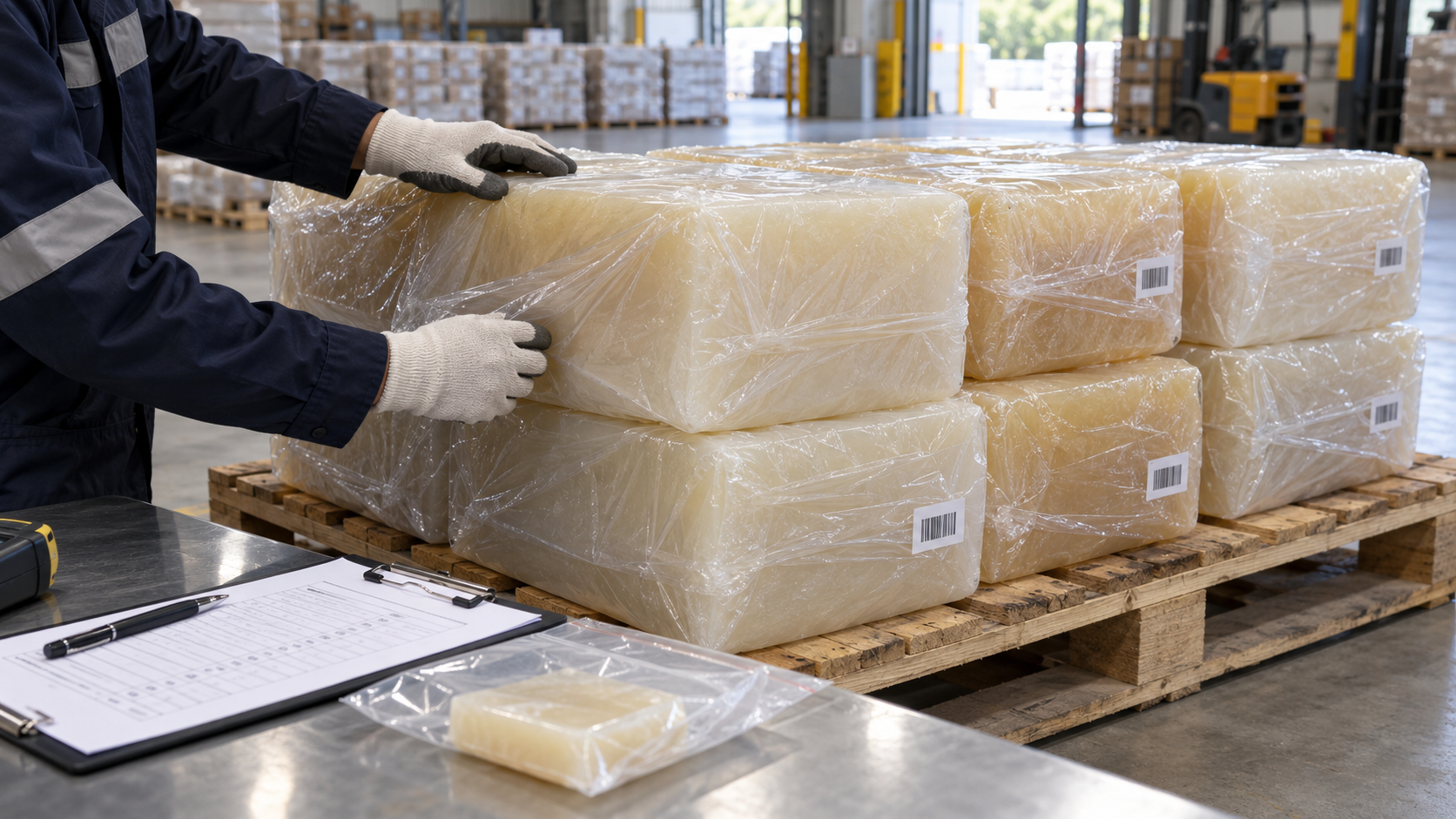
Create a receiving record that links observations to a specific lot. Photograph the shipment condition before removing packaging, especially if wet cartons, broken straps or damaged wrapping are visible. Record the time, delivery reference and affected pallet identifiers.
| Receiving check | Record | Suggested response to a discrepancy |
|---|---|---|
| Material identity | Producer, full grade, supplied form | Hold unidentified or mismatched material pending clarification |
| Lot traceability | Label numbers matched to COA and packing list | Resolve missing or conflicting identifiers before release |
| Date information | Production date and producer storage basis | Review remaining storage period against planned use |
| Packaging condition | Tears, wetness, open wrapping, pallet damage | Isolate affected units and document the condition |
| Visible cleanliness | Foreign material or unusual surface observations | Refer to quality staff; avoid informal acceptance |
| Transport information | Available exposure records and delivery observations | Assess against agreed conditions and producer advice |
These are proposed workflow actions, not standardized acceptance thresholds. Your quality team should define who can release, quarantine or reject a lot and what evidence is necessary.
A normal appearance is useful information but does not establish that every processing property remains within specification. Conversely, an unusual appearance needs investigation before conclusions are drawn. Preserve a representative record and consult the producer about appropriate assessment.
6Rotate stock using dates and release status
First-in, first-out is useful only when arrival order reflects the relevant material dates. If a later delivery contains an older production lot, arrival-based FIFO can leave the older material behind. Where applicable, use a first-expiring, first-out approach based on the producer’s stated storage basis.
Maintain a simple lot ledger containing grade, production date, received date, producer storage period, location, quantity and quality release status. Keep held stock visibly separate from released stock. A planned production allocation should not override a quality hold.
For example, if two lots arrive together but have different production dates, review their remaining storage periods individually. Ask whether the earlier lot can be used within the production plan. If the answer is unclear, resolve the schedule or obtain producer guidance before accepting the allocation.
7Escalate older or exposed stock with useful evidence
When material approaches its stated storage period, or when a transport excursion is suspected, send a structured evidence pack. Include producer, grade, lot numbers, dates, packaging photographs, known storage history, available temperature records and the intended application.
Ask the producer which checks are appropriate and what a satisfactory result would demonstrate. Do not invent a retest extension or treat one measurement as blanket approval for every application. If testing is requested, agree the sampling method, test method, acceptance criteria and responsible laboratory before acting.
Keep the written disposition with the lot record. A decision that can be traced to evidence is more useful than an undocumented statement that the material “should be fine.”
8Frequently asked questions
Can I use an O-ring shelf-life table for NBR bales?
No. ISO 2230 excludes raw rubber, while ISO 7664 addresses raw rubber storage. Obtain the exact bale grade’s producer instructions and storage-period basis. [1, 2]
Does an undamaged wrapper prove that the material is suitable?
No. Packaging condition is one receiving check. Identity, dates, documents, exposure history and any required quality assessment also contribute to the release decision.
Should every grade use the same storage temperature?
No universal limit is proposed here. Use the current instructions for the producer, grade and supplied form, and evaluate actual storage conditions against those instructions.
What should an importer request before shipment?
Request lot-linked documentation, production dates, grade-specific storage guidance, packaging details and the agreed receiving requirements. Resolve missing information before shipment where possible.
9Make storage part of the buying decision
Effective synthetic rubber storage connects the order, shipment and production plan. Identify the exact material, obtain the producer’s instructions, check the delivery, preserve lot traceability and assign clear release responsibility. This workflow helps buyers discuss storage risks before they become production problems.
Planning an SBR or NBR purchase? Send Linwell your requested grade, application, quantity, destination and expected consumption schedule. Ask about the available batch documentation, packaging and storage guidance for the proposed supply. Request a quote or request technical documents.
10Sources
- ISO 7664:2000 — Raw rubber storage scope. Public abstract; confirmed in 2025. The full standard was not purchased or reviewed.
- ISO 2230:2026 — Rubber product storage scope. Public abstract and raw-rubber exclusion.
- ZEON Chemicals — Nipol NBR. Product forms and grade portfolio.
- GDV Transport Information Service — Synthetic rubber. General transport and storage considerations. Individual producer instructions take precedence for a supplied grade.
Leave a Reply