
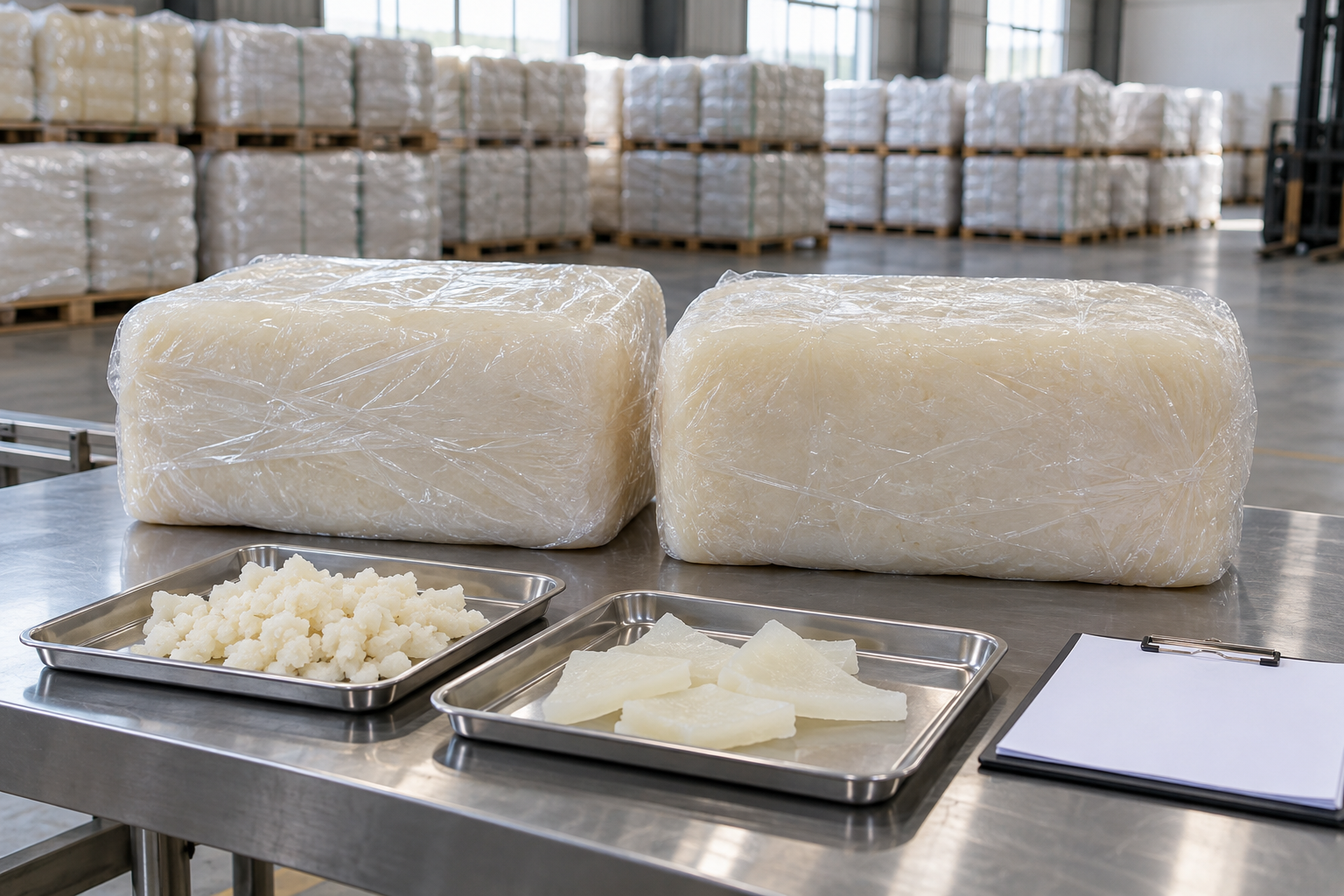


Compare SBR 1502 and SBR 1712 by confirming the producer’s exact grade, oil-extension basis, document specifications and intended formulation. Do not substitute one for the other using bale price or grade numbers alone. An oil-extended material changes the purchasing and recipe comparison and needs an agreed technical review.
Buyers often receive quotations that look similar because both products belong to the emulsion SBR family. The useful comparison begins with what is included in the supplied material. This guide explains which questions to ask before requesting a trial, comparing costs or approving a sourcing change.
1. Begin with the Exact Producer Grade
Record the producer, trade name, grade number and every suffix shown in the quotation. Retain the relevant data-sheet revision. Do not assume that a familiar four-digit designation makes products from different producers identical in every purchasing detail.
Producer product ranges distinguish oil-free and oil-extended SBR families. For example, ARLANXEO’s public product finder identifies Buna SE 1502 L as oil-free E-SBR. Dynasol’s emulsion product guide lists 1712 within its oil-extended SBR range.
Those examples establish useful questions for a buyer, not a guarantee that every offered product has the same specifications. Ask for the documents covering the actual grade being quoted.
2. Confirm the Oil-Extension Basis
Ask whether oil is included in the supplied rubber and, if so, how its type and amount are specified. Preserve the units and reporting basis. Do not interpret a number reported relative to polymer as though it were automatically the same percentage of the supplied bale.
The oil description belongs to the exact product, not just the grade family. Dynasol’s guide distinguishes extender-oil descriptions across its oil-extended grades. A supplier should identify the actual document basis rather than asking the buyer to infer it from the grade number.
Where the destination or application has material restrictions, route the product-specific declarations to the responsible compliance team. A broad family label does not prove that a particular requirement has been satisfied.
3. Compare the Recipe on a Consistent Basis
Changing between an oil-free and an oil-extended supply requires a formulation review. Ask the compounding team how the supplied material will be accounted for in the recipe and which other ingredients or quantities need to be considered.
Keep the calculation basis explicit. Comparing equal purchased masses can be misleading if the materials include different constituents. The engineering comparison should identify what is held constant and what changes.
Do not publish or circulate a universal substitution ratio. The actual formulation, offered product and intended part determine the review. A practical trial plan is more useful than an unsupported claim that the grades are interchangeable.
4. Use a Grade Comparison Checklist
| Question | Evidence to request | Decision supported |
|---|---|---|
| Which exact grade is offered? | Producer, trade name, suffix and current documents | Material identity |
| Is oil included? | Extension basis, oil description and units | Formulation comparison |
| Which properties are specified? | Methods, limits and typical-value qualifications | Technical shortlist |
| What will the shipment contain? | Packaging, net mass, lot identifiers and certificates | Receiving plan |
| How will the change be validated? | Agreed laboratory and production trial requirements | Application approval |
Keep missing fields visible. An incomplete quotation is not evidence of material failure, but it cannot support the same decision as a fully documented proposal. Assign an owner and deadline to each clarification.
A data-sheet value should retain its method, units and qualification as typical or specified. Do not turn a convenient brochure number into an acceptance limit without agreement.
5. Review Processing Evidence Separately
Ask which trial observations are relevant to your mixing and forming process. A supplier’s application suggestion can help frame a discussion, but it does not replace a comparison using the actual formulation and equipment.
Where viscosity or cure information is supplied, keep its test basis and material identity. A result from a reference compound may not describe the buyer’s proposed production formulation.
Our Mooney viscosity and hardness guide helps separate property measurements. Use the relevant evidence together instead of selecting one attractive number as proof of overall processing equivalence.
6. Compare Costs Beyond Bale Price
A lower price per purchased tonne does not automatically establish a lower approved compound cost. Compare the materials using the agreed recipe basis, the proposed ingredient changes, delivered commercial terms and trial evidence.
Record the currency, quotation date, delivery basis, packaging and quantity assumptions. Keep freight and other stated charges visible. Do not compare a delivered quotation with a different commercial basis as though they were identical offers.
Processing yield, rejects and finished-part acceptance may affect the practical decision, but use measured trial information where available. Do not invent savings, market prices or production improvements to complete a spreadsheet.
7. Link the Trial to Routine Supply
Identify the sample lot, producer grade and formulation used during evaluation. Record which requirements passed, which remain open and what the approval actually permits.
Before ordering routine volume, agree the applicable specification revision and certificate coverage for supplied lots. Ask how changes to the offered material will be communicated and reviewed. A successful trial does not automatically approve every later substitution.
Keep a clear record of the approving person and any restrictions. A one-order deviation should not silently become the new purchasing specification for the next delivery.
8. Ask a Better RFQ Question
A useful request is: “Please quote the complete producer grade, confirm whether the supplied material is oil-free or oil-extended, identify the oil-extension reporting basis where applicable, and provide current technical and safety documents for our formulation review.”
Add the application, reference material, trial quantity, document requirements and destination. If the change is still being screened, say so. Do not imply that a purchase inquiry is already an approved substitution.
For document review, see our COA, TDS and SDS checklist. For commercial comparisons, our RFQ pricing guide addresses quotation assumptions separately.
Preserve the final comparison with the order file, including rejected alternatives and unresolved assumptions. This helps the next reviewer understand why the selected material was approved and prevents a later buyer from treating an earlier exploratory quotation as a qualified replacement.
9. Frequently Asked Questions
Are SBR 1502 and SBR 1712 direct substitutes?
Do not assume so. Review the exact producer product, oil-extension basis, recipe and application qualification.
Does the lowest bale price identify the best option?
No. Compare approved formulation and delivered commercial assumptions on a consistent basis.
Can the oil type be inferred from a generic grade name?
Request the exact product document and supplier confirmation rather than relying on the number alone.
Does a passed laboratory sample approve routine production?
Only within the documented approval scope. Complete the agreed production trial and supply controls.
10. Conclusion and Sources
Use the SBR grade number as the start of a purchasing review. Confirm the product identity, oil-extension basis and technical documents, compare formulation costs transparently, and qualify the actual proposed material before routine substitution.
- ARLANXEO product finder: oil-free and oil-extended E-SBR categories
- Dynasol emulsion rubber product guide
Reviewed October 30, 2026. Product examples are producer-specific; this original checklist does not claim universal grade equivalence. Google Trends was inaccessible, and no measured trend claim is made.
Send Linwell the exact reference grade, formulation objective, application, trial quantity, required documents and destination. Ask which product-specific information is available for comparison.
Request a Quote
Leave a Reply