
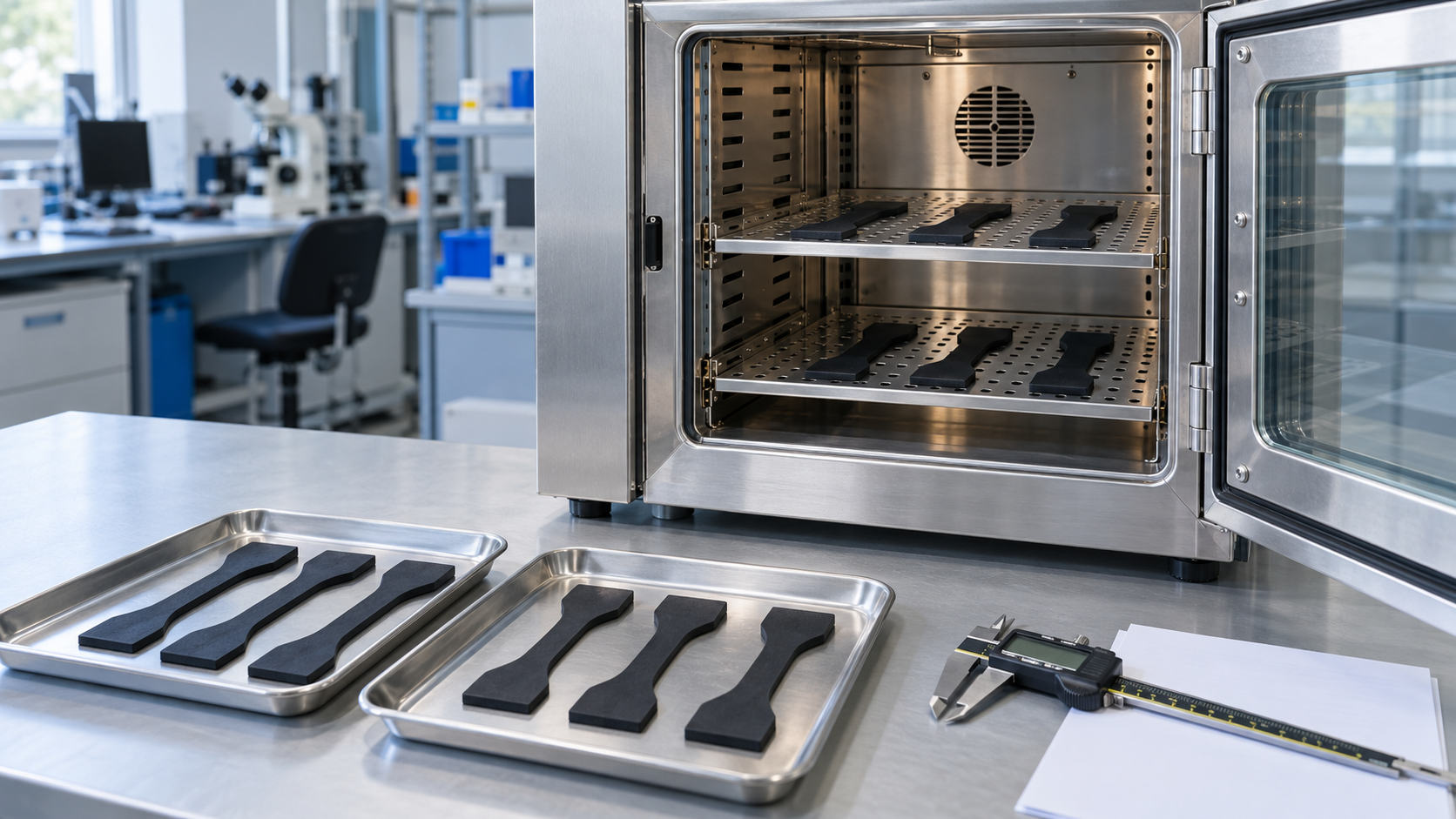


A rubber heat ageing report supports a sourcing decision only when the tested compound, exposure and property comparisons match the approval requirement. It does not, by itself, establish how many years a seal, hose or other component will last. Review the evidence and its limits before accepting a proposed SBR or NBR material change.
1. Key Takeaways
- Identify the tested compound and connect it to the offered material.
- Keep the standard, edition, selected method and exposure together.
- Ask for original and aged results on a clearly defined comparison basis.
- Use limits from the approved specification, rather than inventing universal thresholds.
- Keep laboratory comparison and component service-life approval as separate decisions.
For buyers, the most useful first step is a complete evidence request. A certificate headed heat resistant is not enough to establish the scope of an approval, even when the supplier is familiar and the order repeats a previous grade name.
2. What the Referenced Standards Establish
ISO 188:2023 addresses accelerated ageing and heat-resistance tests for vulcanized and thermoplastic rubber materials. Its public abstract identifies several possible methods. Record which method the laboratory used; the standard number alone leaves that choice unclear.
ASTM D573-04(2025) concerns the effect of elevated temperature on physical properties of vulcanized rubber in an air oven. Its public scope describes laboratory comparisons and cautions that results may not correlate exactly with service performance. Treat that limitation as part of the evidence review, rather than converting an oven exposure into an unsupported service-life promise.
These brief descriptions do not replace the full standards. Agree the applicable procedure with the responsible laboratory before commissioning or comparing tests.
3. Start with the Material and the Buying Decision
Write down whether the purchase is raw polymer, a mixed compound or a finished component. A cured test sheet made from a reference formulation does not describe every possible product made with the same raw NBR or SBR grade. Ask the issuer to state exactly what its report covers.
Connect the sample code to the compound revision, production or laboratory batch, and the material proposed in the quotation. Retain the drawing or internal specification revision that the reviewer is using. If those identities cannot be connected, pause the technical comparison and resolve the document gap.
For raw polymer sourcing, ask what grade-specific documents and trial material are available. Linwell’s technical document guide helps organize the different roles of a TDS, batch COA and safety document.
4. A Heat-Ageing Report Review Matrix
| Review item | Evidence to retain | Question if missing |
|---|---|---|
| Sample identity | Compound, revision and batch link | Does this represent the offered material? |
| Test basis | Standard, edition and selected procedure | Are both reports on the same basis? |
| Exposure | Recorded temperature, duration and test environment | Does this match our agreed requirement? |
| Properties | Before/after values, units and change convention | What exactly does the reported change mean? |
| Acceptance | Specification limits and review decision | Who may approve any deviation? |
Use this as a purchasing review sheet, not as a test instruction. Add the details required by the selected method and your quality agreement. A blank field should generate a clarification request rather than an assumed answer.
5. Check the Exposure Before Ranking Results
Read the exposure statement before comparing supplier numbers. A different duration, temperature or test environment can make a direct ranking inappropriate. Do not summarize several different exposures in one spreadsheet column called ageing performance.
Retain the reported conditions alongside each result and ask the technical reviewer which comparisons are valid. If a supplier offers data from a different basis, record it as supporting information until the reviewer accepts its relevance. Keep any agreed supplementary testing visible in the purchasing plan.
The quotation should distinguish the cost and timing of additional evidence from the material offer. This avoids placing a production order while assuming that an uncommissioned test will later resolve a critical approval gap.
6. Read Before-and-After Values Together
Ask for the original result and the result after exposure, together with the units and calculation convention. Where hardness, tensile properties or elongation are included in the approval plan, retain each as a separate property. A single statement that the sample passed hides the information needed to review a change of supplier.
Do not mix a difference expressed in property units with a percentage change. Have the laboratory clarify the basis and retain its corrected explanation with the original report. Avoid reconstructing missing laboratory results from a rounded marketing chart.
Use the agreed acceptance limits for each required property. An attractive percentage in one row cannot compensate for another requirement that lacks evidence. Our tensile and tear evidence checklist explains why distinct properties need distinct review decisions.
7. Separate Oven Results from Application Approval
Begin the application review with the component’s actual requirements, including the environment and operating conditions provided by engineering. A report from one laboratory exposure should not become a general claim that a polymer family works in every hot application.
If the component also encounters liquids, compression or movement, ask engineering what additional evidence is needed. Do not assume that the air-oven result answers those other questions. Record the remaining checks and the person responsible for accepting them.
When a customer asks for a lifetime statement, explain what the available evidence establishes and seek a defined validation plan. A documented limitation is more useful than a confident number that cannot be traced to the application.
8. Use a Controlled Material-Change Workflow
- Describe the reason for the proposed producer, grade or compound change.
- Retain the approved reference specification and sample identity.
- Agree the heat-ageing evidence needed for the decision.
- Compare reports only after resolving method and exposure differences.
- Record formulation and processing changes made during development.
- Complete the component checks selected by engineering.
- Document approval, restrictions and outstanding actions.
- Link the first delivery and subsequent orders to the approved material definition.
For repeat supply, agree which changes require notification. A new grade name or a familiar supplier code should not silently replace the approved compound revision. Procurement, quality and engineering should work from the same acceptance record.
9. Resolve Gaps Before Releasing the Order
Sort unresolved items into document identity, test comparability and acceptance questions. This produces a more useful supplier enquiry than a general request for better heat resistance. Assign a response owner and retain the report revision to which each answer applies.
If results appear inconsistent, preserve the sample and laboratory records while the parties review the comparison basis. Do not label the material defective solely because two documents disagree. Equally, do not close the issue with an unsupported verbal assurance.
State the approval stage clearly in the RFQ: development sample, controlled trial or approved production supply. Include the intended application, reference grade, required documents, quantity and destination. The supplier can then identify available evidence and outstanding work without implying that a quotation itself is a technical approval.
10. FAQ
Does a heat-ageing test prove a fixed service life?
No. A laboratory comparison does not alone establish a component’s lifetime under its actual service conditions.
Can I compare reports with different exposure times?
Do not rank them as equivalent without technical review. Preserve the exposure details and agree a comparable evidence basis.
Does a raw NBR COA approve a finished seal?
Only the reported batch properties fall within that document’s stated scope. The actual compound and component require their own relevant approval evidence.
What if the report states only pass?
Request the applicable specification, measured results and acceptance basis. Record the decision as pending if evidence critical to approval remains missing.
11. Conclusion and Sources
Approve rubber heat ageing evidence against a defined material, test basis and application requirement. Keep the exposure conditions and before-and-after properties together, and leave unsupported lifetime claims out of the purchase decision.
- ISO 188:2023: public standard identification and scope
- ASTM D573-04(2025): public scope and significance
Reviewed October 18, 2026. Standard references summarize public scopes only; the purchasing checklist is practical review guidance and does not reproduce a laboratory procedure. Google Trends was inaccessible, so this article makes no measured trend claim. The generated cover is illustrative and does not document a Linwell-owned laboratory or a completed test.
Send the reference grade, application, test requirements, trial quantity and destination. Ask which grade-specific technical and batch documents are available before arranging a controlled material trial.
Request a Quote
Leave a Reply