

To compare rubber abrasion resistance, first match the test method, specimen preparation and reporting basis. A wear value without its units and test conditions is not enough to approve a compound or qualify a supplier. Use laboratory results to screen candidates, then validate the shortlisted material in the application.
This guide helps rubber product manufacturers and purchasing teams review supplier reports, prepare a clearer RFQ and avoid comparisons that look precise but answer different questions.
What an abrasion report can tell a buyer
Abrasion testing evaluates material loss under a defined laboratory wear action. It helps compare samples tested on a consistent basis. It does not supply a universal service-life prediction. A conveyor cover, shoe sole and dynamic seal can encounter different contact surfaces, loads and operating environments.
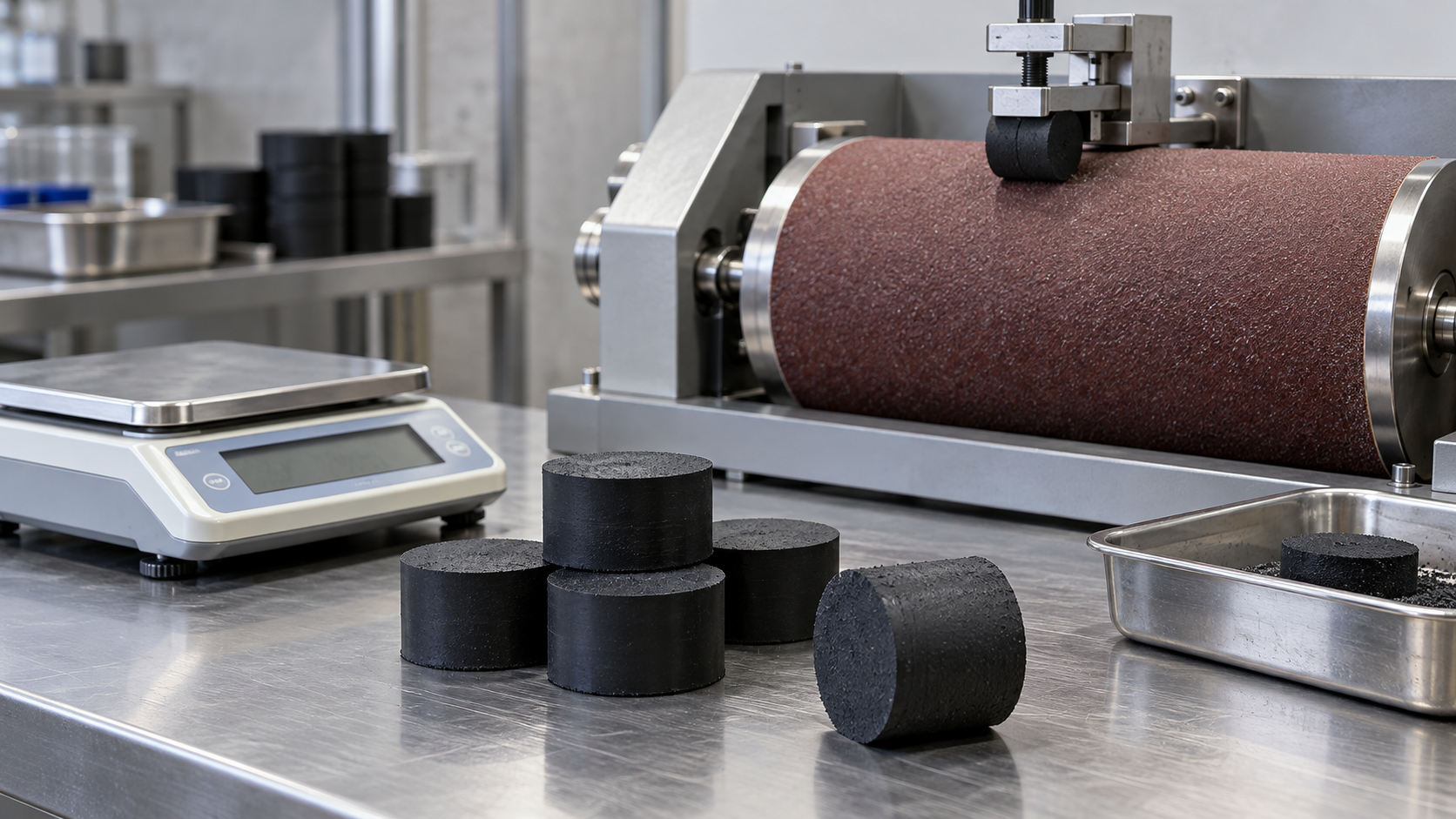
The public descriptions of ASTM D5963-22 and ISO 4649:2024 describe rotating-drum approaches. Both caution against assuming a direct relationship between a laboratory result and actual service performance. Treat the report as one part of material qualification.
For purchasing, ask two separate questions: was the sample tested correctly against the agreed requirement, and does that requirement represent the conditions that matter to your product? A complete answer to the first question does not automatically resolve the second.
Read the result and units together
Check the heading beside the reported number before ranking offers. For a volume-loss result, less material lost indicates better resistance within the comparable test. An abrasion resistance index uses a different basis: a higher index indicates better resistance. Do not put the two types into a single numerical ranking.
If a quotation says only “abrasion: 100,” ask for the original report. Do not infer whether the number represents cubic millimetres, a percentage or an internal supplier rating. Record the property name exactly as reported and retain the laboratory explanation of the calculation basis.
| Report item | What to request | Purchasing decision |
|---|---|---|
| Result basis | Volume loss or resistance index, with units | Compare only like-for-like results |
| Method | Standard, edition and procedure | Resolve differences before ranking |
| Sample identity | Compound code, batch and preparation | Connect the result to the offered material |
| Test conditions | Full report and any deviations | Check against the agreed specification |
| Acceptance | Agreed limit and retest process | Define release or further evaluation |
Match the standard and procedure
The ISO public summary distinguishes method A, using a non-rotating specimen, from method B, using a rotating specimen. This is a reason to request the procedure, rather than accepting “DIN abrasion” as a complete description. A familiar shorthand may omit details needed for a valid comparison.
Ask the laboratory to confirm the applicable edition and whether the report follows it without deviations. When two suppliers cite different standards, do not assume that similar equipment makes the results interchangeable. Request a technical review or arrange a common test plan for shortlisted samples.
Use a comparison sheet with one row per offered compound. Leave a field marked “not provided” when evidence is missing. This prevents an incomplete quotation from appearing equivalent to a fully documented offer simply because both include an abrasion number.
Identify the compound behind the sample
For a buyer sourcing raw SBR or NBR, a cured-compound abrasion report needs context. Ask which formulation and preparation produced the specimen and whether the report describes a supplier reference compound or your intended production compound. Do not present a reference-compound result as guaranteed performance of every finished product made from the polymer.
Request the sample code, production or laboratory batch reference, preparation date and cure details relevant to the comparison. If formulation information is confidential, agree what the laboratory can disclose and how sample identity will be controlled. Confidentiality should not leave the buyer unable to identify what was tested.
Keep the test report, technical data sheet and purchase specification linked by material code and revision. For broader document review, see our synthetic rubber supply chain guide. A clear document trail makes later change discussions easier.
Build an RFQ that suppliers can answer
Describe the product and wear situation before requesting a target value. Include the contacting surface, movement, expected temperature range and relevant exposure to liquids or contaminants. State which information is known and which conditions still need engineering confirmation.
Then separate mandatory requirements from information requested for evaluation. If an abrasion limit has already been validated for the application, cite the agreed method and acceptance rule. If no limit has been validated, request comparative samples and a test proposal instead of copying an unrelated value from a catalogue.
- Identify the polymer or compound being sourced and the intended product.
- Specify the agreed test method, edition, reporting basis and units.
- Request the complete report, sample identity and any deviations.
- Define who provides samples and who performs comparison testing.
- Agree how missing information and disputed results will be resolved.
- State that final approval depends on the agreed application evaluation.
A useful RFQ sentence is: “Please provide abrasion test evidence for the offered compound, including the standard and edition, procedure, result basis, units, sample identification and any deviations; confirm whether the specimen represents the proposed production material.” Adjust it to your qualification plan.
Turn a promising result into a qualification plan
First screen the documents for completeness. Next compare candidates under a common method where practical. Finally evaluate the shortlisted compound or finished component under representative operating conditions. Record what each stage establishes so a document review is not mistaken for product approval.
Consider the other properties required by the part. A low abrasion loss alone does not establish suitability for sealing, flexing or chemical exposure. Review the relevant requirements together; our tensile and tear strength checklist and fluid resistance report guide cover related evidence.
Before a repeat order, agree which material or process changes require notification and whether fresh testing is needed. Keep an approved reference sample where appropriate. The goal is a repeatable purchasing decision supported by identifiable evidence, rather than a one-time comparison of attractive numbers.
Frequently asked questions
Is a lower abrasion number always better?
Only after you identify the result basis. Lower volume loss indicates better resistance within a comparable test; an abrasion resistance index has the opposite direction. Read the units and method before comparing.
Can an abrasion result predict service life?
Do not convert it directly into operating hours or kilometres. Laboratory screening and application validation answer different questions. Ask for evidence representative of the actual product and operating conditions.
Can I select an SBR grade from abrasion data alone?
Use the data as part of a wider qualification. Confirm what compound was tested, how it relates to your formulation and whether other product requirements are satisfied. A polymer name alone does not identify the tested compound.
What if two supplier reports use different methods?
Flag the comparison as unresolved. Ask for a laboratory review or test both candidates under an agreed common protocol. Avoid inventing a conversion factor between reports.
Make the next sourcing decision clearer
A useful abrasion report connects an identifiable sample to a defined method and an agreed decision. Confirm those links before negotiating around a single value. Then use representative evaluation to decide whether the material is suitable for the intended product.
Discuss your SBR or NBR sourcing requirement with Linwell Industry. Send the material or grade, intended application, required quantity and available test specification through our contact page. Include the report you want to compare so the inquiry starts with a clear technical basis.
Sources and scope
Method facts above are based on the public summaries of ASTM D5963-22 and ISO 4649:2024, checked on October 21, 2026. The RFQ and qualification checklists are practical purchasing guidance, not test instructions or a replacement for the applicable standard. No supplier test results or service-life claims are presented.
Leave a Reply