
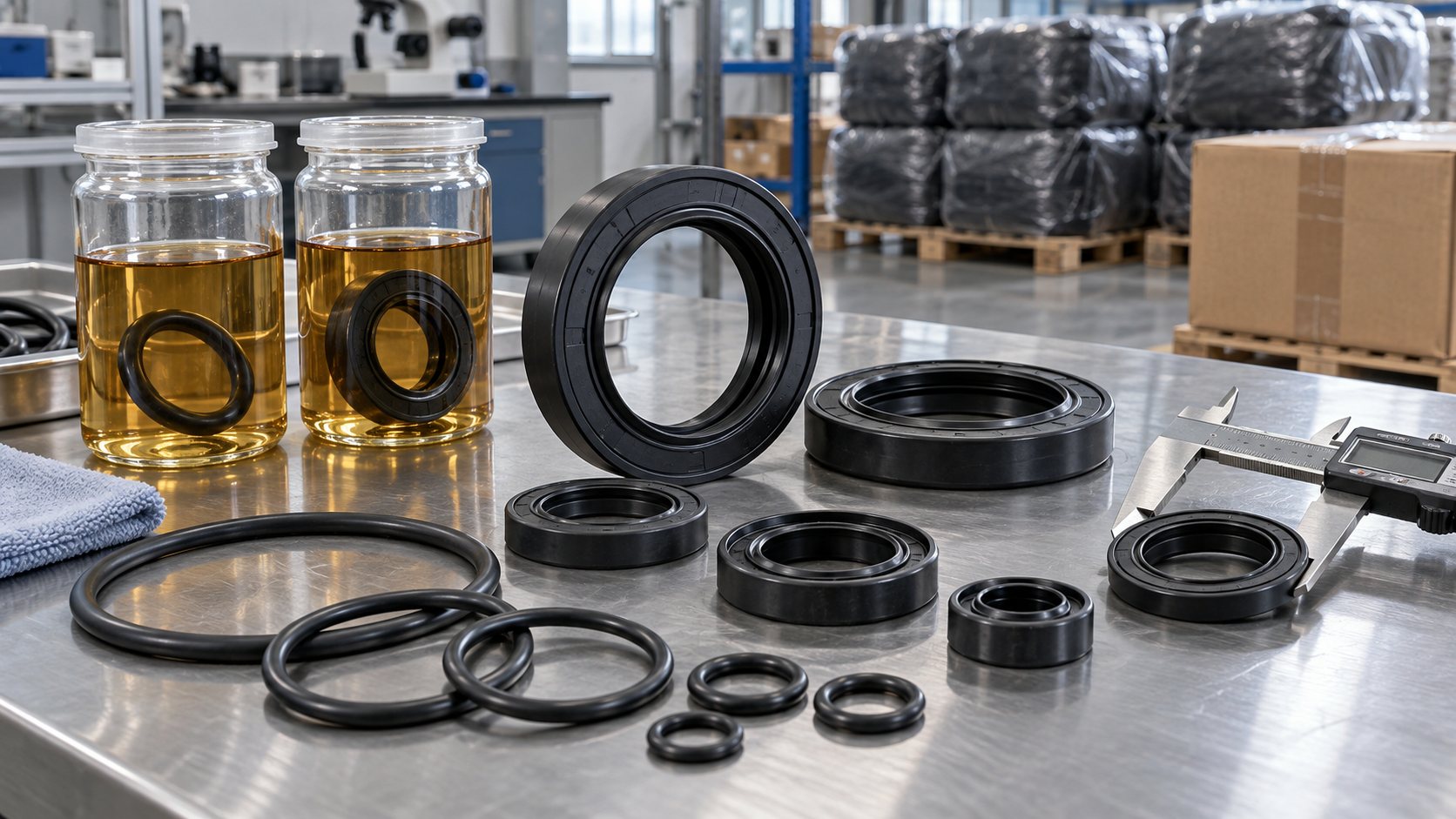


1Should you choose NBR or FKM for an oil seal?
Choose NBR when the seal operates mainly with compatible petroleum oils or hydraulic fluids at moderate temperatures and the project needs a practical balance of oil resistance, low-temperature flexibility, processing, and cost. Choose FKM when sustained heat, fuels, aromatic hydrocarbons, ozone, or a broader chemical environment exceeds the capability of the qualified NBR compound.
That answer is only a screening rule. An oil seal is a finished compound and a mechanical system, not a polymer name. The correct decision also depends on the exact fluid and additives, minimum and maximum temperatures, pressure, shaft speed, surface finish, compression set, seal geometry, cure system, and expected service life.
For procurement, the useful question is therefore not simply “NBR or FKM?” It is “Which tested compound meets the documented service window in this seal design?”
2What NBR and FKM mean
NBR is nitrile-butadiene rubber, a copolymer of acrylonitrile and butadiene. FKM is the ISO and ASTM family designation for fluorocarbon elastomers. ISO 1629:2025 standardizes symbols for basic rubbers, while ASTM D1418 provides a chemical-composition-based nomenclature used in North American specifications.
NBR is widely used in oil seals, O-rings, gaskets, hoses, rolls, and molded parts because it combines resistance to many petroleum fluids with useful mechanical properties. FKM is normally selected for higher heat and more demanding fuel or chemical exposure. Neither designation identifies one universal formulation: different polymers, fillers, plasticizers, cure systems, and post-cure conditions can produce materially different results inside the same family.
3NBR vs FKM: a procurement comparison
| Decision factor | NBR | FKM | Buyer action |
|---|---|---|---|
| Typical fit | Mineral oils, many hydraulic fluids, greases, general industrial sealing | Higher-temperature oil and fuel service; many aromatics and demanding chemical environments | Name the exact fluid, concentration, additives, and contamination risks |
| Temperature screening | Parker lists approximately −34 to 121°C for general-service nitrile, with special low-temperature nitrile extending lower | Parker lists approximately −26 to 205°C for general fluorocarbon | Do not copy catalogue limits into a specification; verify the compound in the real medium and duty cycle |
| Low-temperature flexibility | Often better, especially with lower-ACN or purpose-designed grades | Often the limiting factor for standard FKM, although special low-temperature grades exist | Specify the cold-start condition and test after fluid aging |
| Heat and weathering | Moderate; compound-dependent | Generally stronger for sustained heat, ozone, and weathering | State continuous temperature, peaks, time at temperature, and air or fluid exposure |
| Fluid compatibility | Strong with many petroleum oils; weaker with many aromatics and polar solvents | Broad oil, fuel, and aromatic resistance; standard FKM is not universal | Use a compatibility table only to shortlist, then run immersion and seal tests |
| Commercial decision | Often the practical starting family for standard oil seals | Higher-performance option when the service case justifies it | Compare total failure risk and validated service life, not polymer price alone |
Temperature ranges in handbooks are approximate family-level guidance. Seal geometry, formulation, fluid, pressure, motion, and test criteria can narrow the usable range.
4Why NBR acrylonitrile content matters
Acrylonitrile content, commonly shortened to ACN, is one of the first grade variables to check when sourcing NBR. Raising ACN generally improves resistance to oil and fuel swelling, but it reduces low-temperature flexibility. Lower ACN moves the balance in the other direction.
Zeon’s current Nipol NBR portfolio illustrates the size of this design space: published grades span about 19% to 50% ACN and are further separated by Mooney viscosity, polymerization chemistry, physical form, and specialty modification. Its public grade table also shows that glass-transition temperature changes across the ACN range. This is why “NBR 3345” or “medium-high nitrile” should not be treated as a complete seal specification.
A practical ACN decision rule
- If oil or fuel swelling is the main failure risk, evaluate a higher-ACN NBR grade first.
- If cold start, flexing, or low-temperature sealing is critical, evaluate a lower-ACN or dedicated low-temperature grade.
- If both demands are severe, test special NBR, HNBR, or FKM compounds rather than assuming one standard grade can cover the entire window.
ACN is not the only control variable. Mooney viscosity affects mixing and flow; the cure system affects compression set and heat aging; fillers and plasticizers alter hardness, modulus, extraction, and shrinkage. Buyers should therefore qualify the finished compound or seal, while using the raw-polymer data to control sourcing consistency.
5A five-step NBR vs FKM selection process
Step 1: define the fluid precisely
Record the commercial fluid name, base oil, additive package, concentration, and possible contaminants. “Hydraulic oil” is too broad for final approval. Include cleaning chemicals and temporary process fluids because short exposure can damage a seal before normal service begins.
Step 2: define the temperature profile
Separate continuous temperature, peak temperature, cold start, and thermal cycling. A seal that survives a short hot peak may still lose sealing force after long-term compression at a lower temperature. A compound that is flexible in dry cold air may behave differently after oil immersion.
Step 3: define the mechanical duty
State whether the seal is static or dynamic, the pressure, shaft speed, eccentricity, surface finish, groove dimensions, and expected installation stretch. FKM’s heat capability does not compensate for an incorrect lip design, and NBR’s abrasion resistance does not remove the need to control the counterface.
Step 4: convert service needs into tests
For the compound, specify hardness, tensile properties, elongation, compression set, heat aging, and volume change after immersion in the actual or agreed reference fluid. ASTM D2000 organizes elastomer requirements by heat-aging type and oil-swelling class, then adds suffix requirements. It is a useful language for specifications, but the detailed product drawing and agreed test limits take precedence.
Step 5: validate the finished seal
Run dimensional inspection, material tests, and an application-representative bench trial. Use at least two production lots when repeatability matters. Approval of one laboratory slab does not prove that the production oil seal has the correct dimensions, cure state, surface, or long-term sealing force.
6Documents and tests to request
Ask for documents that connect the polymer, compound, production lot, and finished part. A generic NBR data sheet cannot verify a specific seal shipment.
- Raw-polymer TDS: grade designation, ACN or fluorine-related grade information where published, Mooney viscosity, form, storage guidance, and test methods.
- SDS: current handling, storage, and regulatory information for the supplied material.
- Batch COA: lot number and actual measured values for the agreed incoming controls.
- Compound specification: polymer family, hardness, cure system where relevant, color, density, and required physical-property limits.
- Fluid-aging report: fluid, temperature, time, sample geometry, and changes in volume, hardness, tensile strength, and elongation.
- Finished-part inspection: dimensions, visual criteria, traceability, and any functional leakage or endurance test.
When a supplier proposes an “equivalent” grade, compare the specification windows and test methods line by line. A matching polymer label does not establish equivalence.
7Oil-seal RFQ checklist
- Part type and drawing revision
- Static or dynamic duty; shaft speed and pressure
- Exact fluid, additives, concentration, and cleaning exposure
- Continuous, peak, and minimum-start temperatures
- Required polymer family or permission to propose alternatives
- For NBR: target ACN band or required oil-swell and low-temperature results
- Hardness and dimensional tolerances
- Heat-aging, compression-set, and fluid-immersion methods and limits
- Required TDS, SDS, COA, traceability, and regulatory declarations
- Packaging, labeling, storage, destination, and sample-approval plan
Provide the service conditions before asking for a grade recommendation. This lets suppliers compare the same duty and reduces quotations that look equivalent but describe different materials.
8FAQ
Is FKM always better than NBR for oil seals?
No. FKM usually provides higher heat capability and broader resistance to fuels and aromatics, but standard FKM may be less suitable for cold service, and its additional performance may be unnecessary. The best material is the qualified compound that fits the complete duty cycle.
What ACN content should an NBR oil seal use?
There is no universal percentage. Higher ACN generally improves oil and fuel resistance; lower ACN generally improves low-temperature flexibility. Select a starting band from the fluid and minimum temperature, then verify the finished compound by testing.
Can a chemical compatibility chart approve a seal?
No. A chart is a screening tool. It cannot reproduce the exact compound, additive package, temperature cycle, pressure, motion, or seal geometry. Use it to shortlist materials and define the verification plan.
Should buyers specify ASTM D2000?
ASTM D2000 can provide a common material-classification language based on heat aging and oil swelling. Add the exact suffix requirements, test conditions, drawing controls, and application-specific acceptance limits needed for the part.
What should be checked when changing NBR suppliers?
Compare ACN, Mooney viscosity, polymerization type, form, antioxidant or specialty modification where disclosed, test methods, storage guidance, COA controls, and the results in your reference compound. Repeat the production trial with more than one lot before routine release.
9Conclusion
NBR is the practical first candidate for many moderate-temperature oil seals; FKM becomes the stronger candidate when sustained heat, fuels, aromatics, ozone, or chemical breadth moves beyond the qualified NBR window. The selection should still be made at compound and part level.
Start with fluid, temperature, and mechanical duty. Translate those conditions into measurable requirements, compare supplier documents using the same methods, and validate the finished seal in an application-representative test. That process produces a defensible material decision and a clearer RFQ.
Need help matching an NBR grade to an oil-seal compound? Send Linwell the application conditions, target ACN or performance window, test methods, documentation needs, packaging requirements, and destination. We can help organize a grade-matching and sample-evaluation discussion without treating a catalogue range as a supply guarantee.
10Sources
- ISO 1629:2025 — Rubber and latices — Nomenclature
- ASTM D2000-18(2024)e1 — Classification System for Rubber Products in Automotive Applications
- Parker O-Ring Handbook, ORD 5700
- Zeon Chemicals — Nipol NBR product and grade information
- ARLANXEO — Krynac NBR overview
- Lion Elastomers — NBR expansion announcement, February 24, 2026
- Dynasol Group — NBR capacity increase, March 20, 2026
Technical information is provided for general selection guidance. Confirm compound-specific specifications, compatibility, regulatory requirements, test limits, and commercial terms in writing before ordering.
Leave a Reply