


1Key Takeaways
- Qualify an NBR source by application fit, repeatable grade data, document control and a controlled plant trial, not by grade name alone.
- Compare acrylonitrile content, Mooney viscosity, cure behaviour, oil-resistance test conditions, packaging and supplier change control.
- Use more than one commercial lot to confirm consistency before approving routine supply.
This guide gives purchasing teams, compounders and technical managers a practical NBR qualification workflow for seals, hoses, foam and industrial moulded parts.
2Why NBR sourcing matters in 2026
Google Trends comparison data for the past 12 months shows broader worldwide interest in “synthetic rubber” than in the narrower terms “NBR rubber” and “SBR rubber.” Within related rising searches, “NBR foam” increased by roughly 120%. Google Trends is a normalised indicator rather than an absolute demand forecast, but the pattern suggests that buyers are searching both at material-family level and for application-specific NBR solutions.
Supply-side activity also deserves attention. In February 2026, Lion Elastomers announced an expansion into NBR and said it was targeting commercial production from September 2026. The company identified industrial hose, gaskets, seals, mats, custom compounding and PVC modification among the intended markets. The International Institute of Synthetic Rubber Producers also released its 2026 edition of Worldwide Rubber Statistics, reflecting the industry’s continued focus on production, capacity and regional supply data.
These signals do not mean every NBR grade is interchangeable or that new capacity is automatically qualified. They mean procurement teams may see more supplier options and more pressure to compare them consistently. A documented qualification process is therefore more useful than a simple price comparison.
3What an NBR grade really controls
NBR is a copolymer of acrylonitrile and butadiene. Its performance depends on polymer composition, molecular-weight distribution, polymerisation route, stabilisation and the complete compound formulation. Increasing acrylonitrile content generally improves resistance to many hydrocarbon oils and fuels, while low-temperature flexibility can move in the opposite direction. The correct balance must be selected for the service fluid and temperature window.
Mooney viscosity is another important processing indicator, but it should not be used alone. Two materials with similar headline viscosity can still differ in mixing behaviour, filler incorporation, extrusion response, scorch safety or cured properties. Producer portfolios from ARLANXEO and Zeon illustrate why NBR families contain multiple grades with different acrylonitrile levels, viscosity ranges and intended processing routes.
For qualification, connect every raw-material property to a finished-part requirement. If the application is a fuel hose, fluid compatibility and extrusion behaviour may dominate. For foam, cell structure, density control and expansion consistency become critical. For seals, compression set, hardness retention and volume change after fluid immersion may matter more than the uncured polymer data alone.
4NBR supplier qualification checklist
| Qualification item | What to compare | Why it matters |
|---|---|---|
| Grade identity | Producer, grade code, polymer type and manufacturing site | Prevents approval of an ambiguous “equivalent” material |
| Acrylonitrile content | Typical value, tolerance and test method | Influences oil resistance and low-temperature behaviour |
| Mooney viscosity | Test temperature, rotor, preheat time and acceptance range | Supports repeatable mixing and forming |
| Volatile matter and ash | Specification limits and methods | Helps control storage, processing and contamination risk |
| Standard evaluation | ASTM D3187 or another agreed standard formula | Creates a consistent basis for comparing samples |
| Lot documents | COA fields, lot number and traceability | Links incoming material to test evidence |
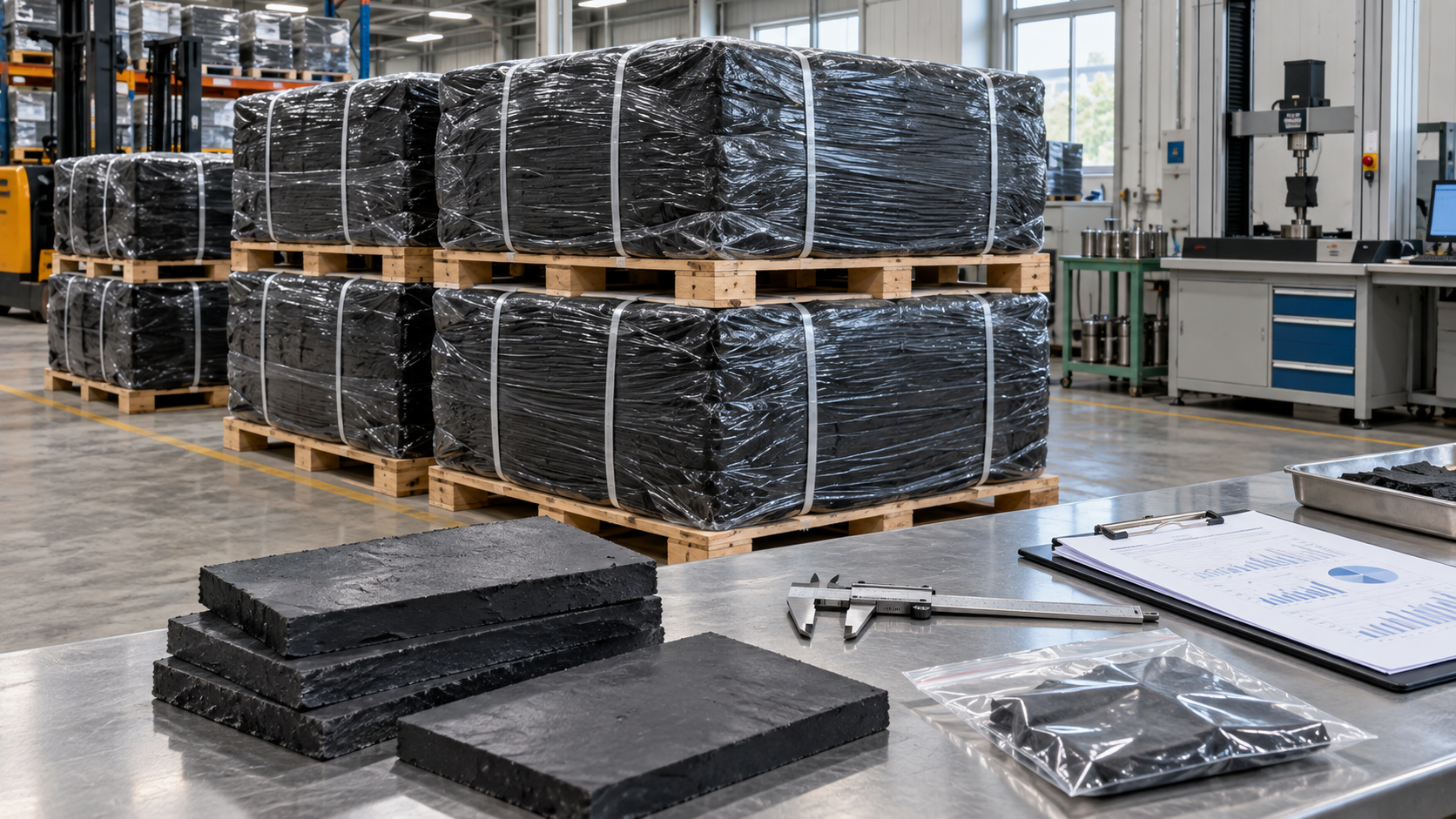
| Packaging | Bale weight, wrapping, pallet pattern and labels | Protects material and supports warehouse control |
| Change control | Notification process for site, formulation or specification changes | Reduces unplanned production variation |
ASTM D3187, updated in 2026, covers standard materials, test formulas, mixing procedures and test methods for evaluating NBR. ASTM states that the methods may support customer control acceptance and comparison of rubber samples. For finished-product specifications, ASTM D2000 classifies rubber materials by heat-aging type and oil-swell class, while ASTM D5964 defines reference immersion oils used with oil-resistant rubber evaluations. Your purchase specification should identify the exact edition and test conditions agreed with the supplier.
5Application-specific questions
NBR for seals and gaskets
Define the actual fluid, concentration, operating temperature, pressure cycle and expected service life. “Oil resistant” is not a complete specification. Test volume change, hardness change and retained tensile properties after immersion under agreed conditions. If temperature, sour gas, ozone or aggressive chemicals are involved, confirm whether standard NBR remains appropriate or whether another elastomer family is required.
NBR for hoses
Review extrusion stability, surface quality, adhesion to reinforcement or cover compounds, fuel or oil compatibility and low-temperature bend performance. A laboratory slab result cannot fully predict hose processing, so the plant trial should include extrusion pressure, line speed, dimensions and cure behaviour.
NBR for foam
For NBR foam, evaluate compatibility with the blowing system, cell uniformity, density, shrinkage, compression behaviour and surface finish. Rising search interest in “NBR foam” is useful for topic discovery, but grade selection still depends on the intended foam process and performance specification. Ask suppliers for relevant application history without treating it as a substitute for your own trial.
6Documents to request before a trial
- Technical data sheet: grade description, typical properties, specification limits and referenced test methods.
- Safety data sheet: current revision, regulatory identity and handling guidance.
- Representative COA: the fields and limits that will appear for each shipment lot.
- Packaging specification: bale weight, wrapping material, palletisation, labels and container-loading method.
- Origin and producer statement: manufacturer and production location, particularly where an approved-source list applies.
- Change-control statement: how customers are notified before a material, process or site change.
- Traceability evidence: the link between bale label, lot number, COA and shipment documents.
Check that product names, units and test methods match across documents. A polished data sheet is not enough if the COA uses different parameters or the shipping labels cannot be reconciled with the lot record.
7A low-risk plant trial plan
- Desk review: compare specifications, documents and known formulation constraints before requesting material.
- Laboratory comparison: test the candidate and approved control in the same formulation, on the same equipment and under the same conditioning rules.
- Controlled production trial: record mixing energy, dump temperature, mill or extrusion behaviour, cure data, scrap and final-part results.
- Repeat-lot confirmation: evaluate more than one commercial lot before concluding that supply consistency is acceptable.
Set acceptance limits before the trial begins. If the candidate requires a formulation or process adjustment, document it as a controlled change rather than quietly altering the baseline. The objective is not to prove that two polymers are identical; it is to show that the candidate stays inside the process and performance window your product needs.
8Frequently asked questions
Can two NBR grades with the same Mooney viscosity be substituted?
Not automatically. Acrylonitrile content, molecular structure, stabilisation, viscosity distribution and cure response can differ. Compare the full specification and run a controlled compound and production trial.
Which document is most important for incoming control?
The COA connects the delivered lot to measured acceptance data, but it should be used together with the approved specification, TDS, SDS and traceability labels. No single document replaces the complete control package.
How many lots should be qualified?
There is no universal number. Risk, application criticality and customer requirements should determine the plan. More than one commercial lot is normally needed to assess repeatability rather than one-sample performance.
Does NBR resist every oil and fuel?
No. Compatibility depends on the NBR grade, compound, fluid chemistry, temperature, exposure time and required property retention. Test the finished compound under representative service conditions.
9Build a qualification package before you buy
NBR sourcing is most reliable when commercial comparison follows technical qualification. Start with a clearly defined application, compare complete grade data, align documents and test methods, then confirm performance across controlled trials and repeat lots.
Need help comparing an NBR grade or preparing a trial package? Send Linwell Industry your current grade, application, target properties, estimated quantity and destination. We can review the available supply route and supporting documents before quotation or sampling.
10Sources
- Google Trends: NBR rubber, SBR rubber and synthetic rubber comparison
- Lion Elastomers: expansion into NBR
- IISRP: Worldwide Rubber Statistics 2026 announcement
- ASTM D3187-06(2026): Evaluation of NBR
- ASTM D2000: Classification of rubber products
- ASTM D5964: Reference immersion oils
- Zeon Chemicals: Nipol NBR grade information
- ARLANXEO: Krynac NBR overview
Technical note: This article provides a purchasing and qualification framework. Final material selection and test limits should be agreed by the buyer, compounder, product designer and supplier for the specific application.
Leave a Reply